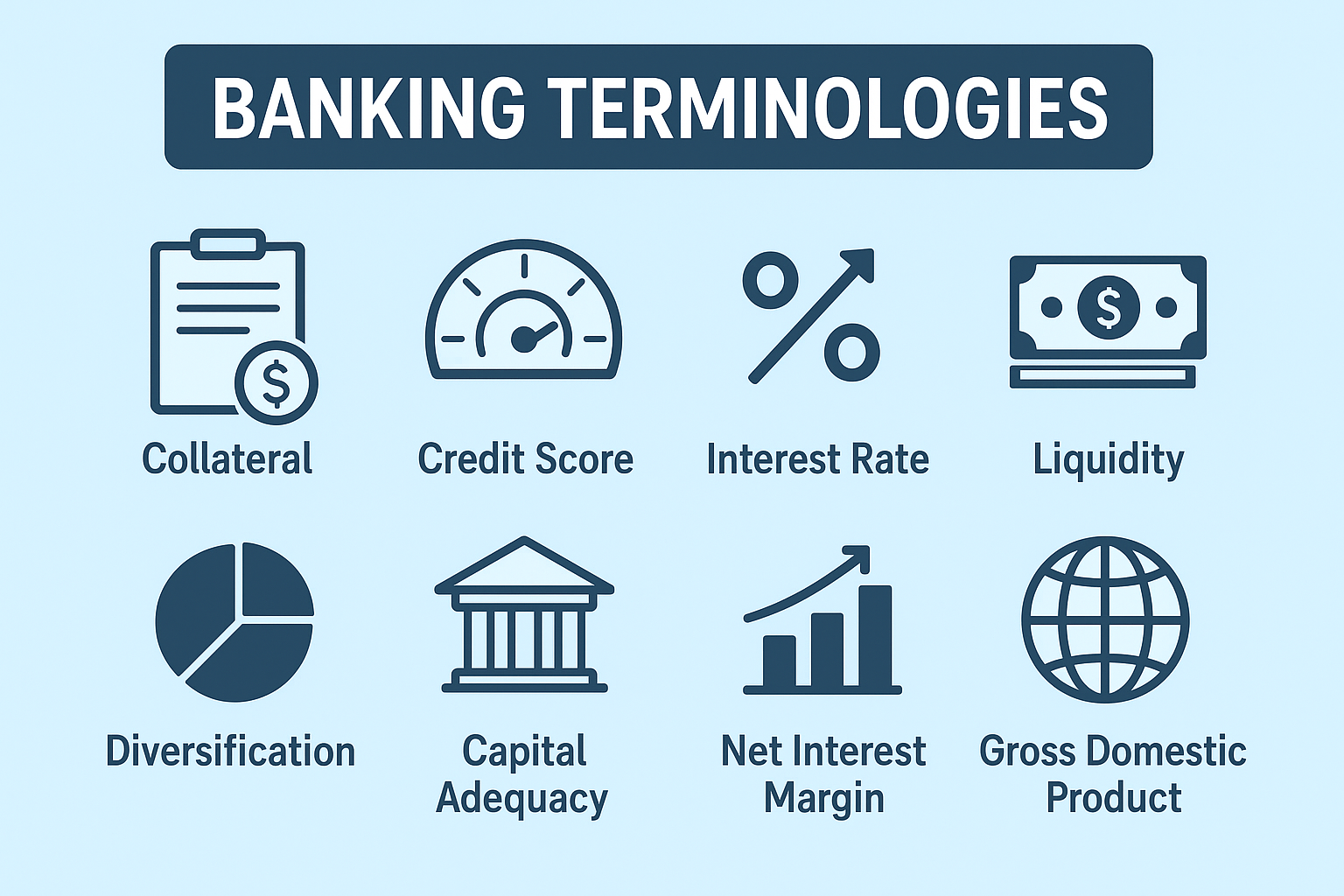
Interest Rate: Interest rate is the profit rate/ return rate you will get on your savings or it is the cost of money you will pay on borrowings.
Account Balance: Account balance is the total amount available in your account on particular date or time i.e. account balance on 31st June or account balance today.
Compound Interest: Compound interest is earning profit on both your original amount as well as on previously earned profit.
Inflation: Inflation is a rate at which prices of goods and services rise in a particular time. It can also be said as reduction in purchasing power.
Liquidity: Liquidity is how quickly you can convert your asset into cash without losing its original value.
Equity: Equity is type of investment as ownership in a company in shape of share of stock.
Debt: Amount of money borrowed that should be repaid with or without interest as per agreement.
Diversification: Spreading your investment in different assets to decrease risk.
Risk: Likelihood of loss of an investment.
Return: Potential gain on an investment.
Credit Score: It is your creditworthiness represented by a number that shows how trustworthy you are in repaying borrowed money.
Mutual Fund: It is a pool of investors’ money that is used to invest in diversified assets.
Bond: It is a fixed income investment or security where you lend money to a company or government for profit.
Dividend: It is the profit distributed by a company to its shareholders.
Capital Gain: Capital gain is a profit which is earned by selling an asset at a higher price than you buy it.
ROI (Return on Investment): How much amount you earned/ lost in percentage compared to amount you invested.
KYC (Know Your Customer): The process of verification banks and financial institutions use to confirm your identity.
Withdrawal: Taking your money out of your bank account.
Deposit: Putting money into your bank account
ATM (Automated Teller Machine): Machine used to make financial transactions electronically.
PIN (Personal Identification Number): Security code which is used to access financial services.
Available Balance: Available balance in bank account ready for withdrawal.
SWIFT Code: It is a code which is used between banks for transferring money internationally.
Digital Banking: Branchless banking channel i.e. online banking, mobile banking or web-banking.
OTP( One Time Password): Temporary security code provided by bank for transaction authenticity and used for one time.