
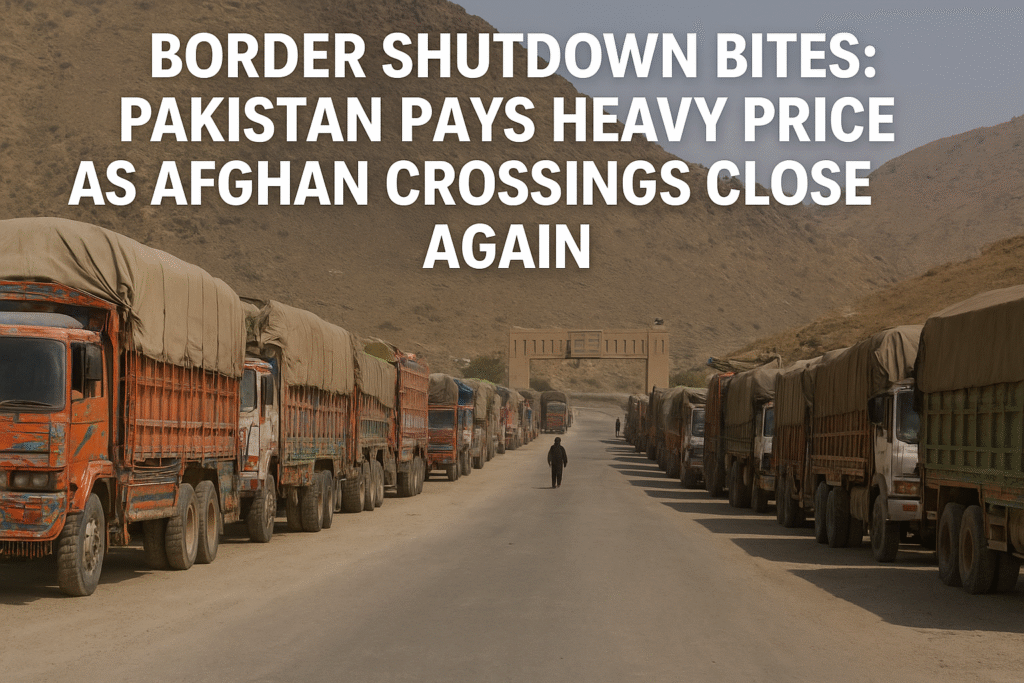
“Border Shutdown Bites: Pakistan Pays Heavy Price as Afghan Crossings Close Again”
Pakistan’s fragile economic recovery has taken a fresh hit as the closure of major border crossings with Afghanistan enters another week, choking key trade routes and triggering sharp price hikes across domestic markets. The shutdown, enforced after renewed clashes between Pakistani forces and militants operating near the frontier, has halted commercial activity at Torkham, Chaman, Ghulam Khan and other vital gateways — leaving hundreds of trucks stranded and millions of dollars’ worth of goods stuck in limbo.
Traders warn the disruption is already inflicting severe losses. Perishable items such as tomatoes, fruit, poultry and fresh vegetables have begun to rot in containers, forcing exporters to absorb heavy financial damage. Imports have also stalled, creating shortages inside Pakistan’s markets and pushing prices sharply upward. Tomatoes in particular have surged to record levels in several cities as Afghan supplies remain blocked, compounding inflationary pressures on ordinary households.
Industrial sectors dependent on Afghan transit trade are feeling the shock as well. Cement, pharmaceuticals and construction-related industries — which regularly export to Afghanistan — report declining shipments and rising production costs. The stoppage of Afghan coal imports, used by multiple Pakistani manufacturers, has further tightened supply chains and increased input costs, threatening profit margins at a time when businesses are already struggling with high energy prices.
Business chambers across Khyber Pakhtunkhwa have expressed alarm, noting that Pakistan has been steadily losing its market share in Afghanistan due to repeated closures over the past two years. With Iranian, Turkish and Central Asian suppliers stepping in, exporters fear that long-term clients may permanently shift away from Pakistani goods if the instability persists. “Every closure pushes Afghan buyers toward alternative markets,” one trader said. “Once those ties are established, it’s very difficult to win them back.”
Government officials argue the restrictions are necessary to curb militant infiltration and secure the border amid rising security threats. However, economists caution that prolonged closures risk widening Pakistan’s trade deficit, reducing customs revenue, and intensifying inflation. The standoff has also raised diplomatic tensions between Islamabad and Kabul, with both sides accusing each other of failing to prevent cross-border attacks.
As negotiations resume quietly behind the scenes, traders and transporters continue to wait along the dusty frontier, watching their livelihoods erode with each passing day. With rising prices, stranded exports, and a market already under pressure, Pakistan is once again caught between the demands of national security and the economic cost of a closed border — a dilemma growing more expensive with every hour the gates remain shut.